“You must have gotten a great score on the SAT.”
“I bet learning legal, anatomical, or medical terminology is so easy for you.”
The above statements are among the most common responses to telling people that I know Latin. And while they are commonly true of Latin students, many will not hesitate to tell you that a good SAT score and a thorough understanding of etymology are not the most valuable or fondly remembered remnants of their Latin education.
My personal decision to start taking Latin as a middle schooler was not inspired by any grandiose intellectual aspiration; Instead, I was driven by a desire to learn a language that was not Spanish and an interest in Greek and Roman mythology. Up to that point, foreign language had been unarguably my worst subject. When the opportunity arose to learn a new language in middle school, I said, “OK, I’ll give it a try”. That “try” evolved into a 7-year-long sequence of Latin and Greek coursework and avid participation in competitions and conferences for Latin and Greek students.
There are certain conveniences to being a Latin student that do relate to learning other school subjects – for example, the ability to understand the meaning of obscure words without a dictionary and an understanding of historical and mythological references in Shakespearean plays.
There is also something inherently fascinating about Roman civilization and the Latin language that kept students signing up for Latin class year after year:
- How did the Romans figure out how to build a large, architecturally sound dome (i.e., the Pantheon) despite living far before modern technology?
- How did Rome grow from a small town that harbored criminals in 753 B.C. to an empire stretching across much of the European continent and Mediterranean world?
- What did people in that time period think about philosophy, education, satire, or art?
- How did this particular word become the Italian or Spanish word for “flower”?
But the best thing about learning Latin was the community of scholars I had the privilege of engaging with. The students in my Latin class were friends who inspired me to be the best version of myself every day. They were intellectually engaged, naturally curious, and possessed a desire to be a positive force of change in their world.
All of us took different paths in life. However, what we became from a career standpoint is not as important as our common desire to understand how societies evolved and changed – and the lessons that knowledge offers for the future. If you walked into a Latin class today, you would see a classroom full of students with their hands raised, excited to contribute their thoughts and questions about such a fascinating language and time in history.
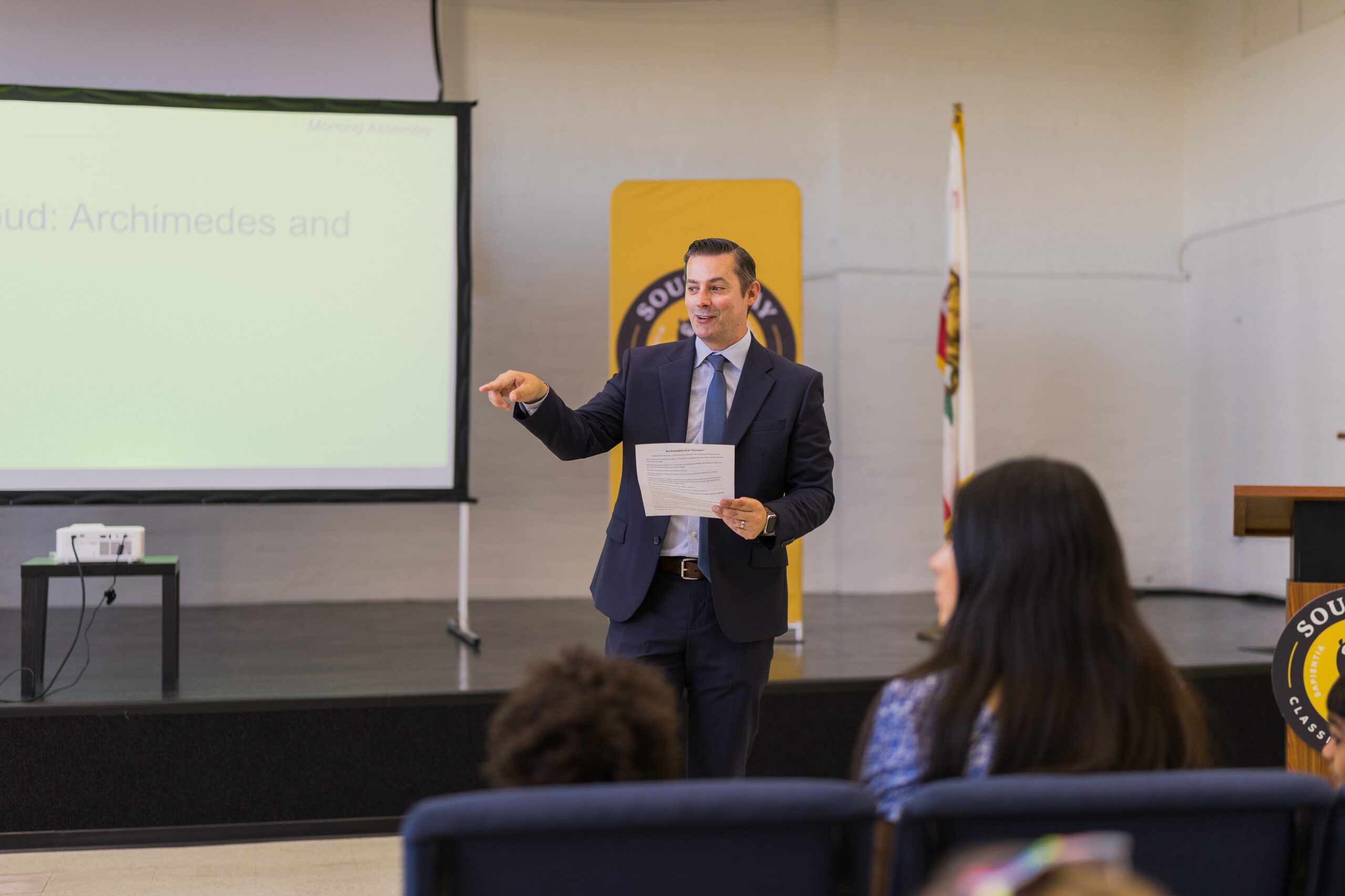
Working at South Bay Classical Academy (SBCA) has brought my experience as a Latin student full circle. We now have the opportunity to share the sense of community, curiosity, and fascination that comes with being a Latin student with our students. At SBCA, we of course want our students to be able to read Latin and develop an appreciation for classical civilization. However, regardless of linguistic skill, we hope first and foremost our Latin scholars will become curious life-long learners who care about what this world was, what it will become, and who have an appreciation for the beauty of life itself.
So when people ask me why I took Latin, “a dead language”, for 7 years, I would tell them it was because I hoped to lead a fulfilling life and make a positive impact within my community. I hope something like this is what our young scholars at SBCA will one day say when someone asks them why they learned Latin.